Africa’s Economy Holds Firm as Growth Reaches 4.2% Despite Global Turbulence
- Aug 9
- 2 min read
Africa’s economy is continuing to show resilience despite a difficult global environment marked by geopolitical tensions, high borrowing costs, trade uncertainty and pressure on public finances. Across the continent, growth is being supported by a combination of domestic demand, infrastructure investment, expanding services, agricultural production and stronger regional trade.
While the pace of growth differs significantly from one country and region to another, the broader outlook remains relatively positive, particularly when compared with the pressures facing many economies globally. The challenge now is ensuring that this resilience translates into more jobs, stronger industries, better infrastructure and improvements in everyday living standards.

The African Development Bank projects the continent to grow by around 4.2% in 2026, with momentum expected to remain relatively strong into 2027. The outlook suggests that, while global conditions remain challenging, many African economies are continuing to expand through a combination of infrastructure investment, agricultural production, services, domestic demand and stronger regional trade.
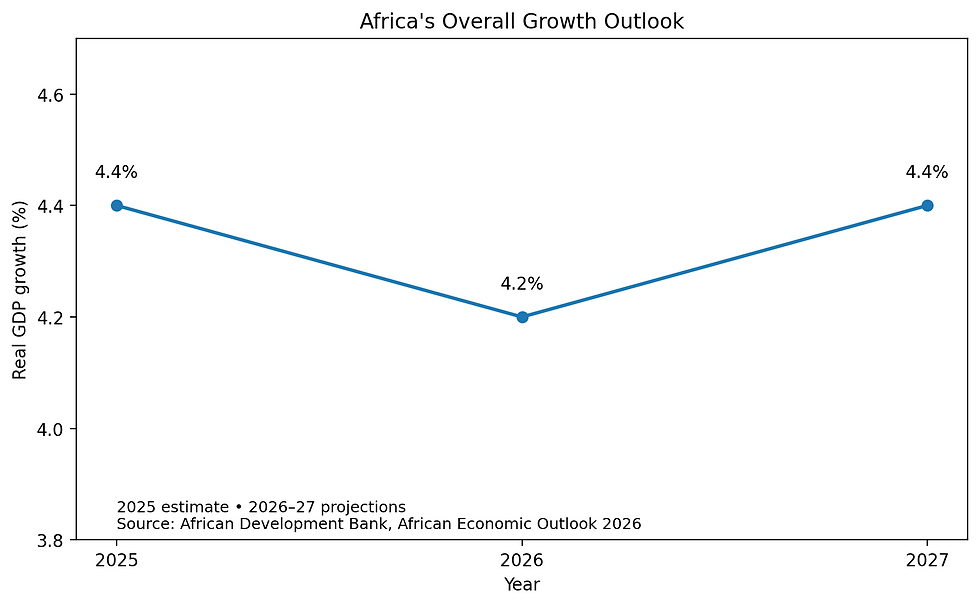
Growth, however, is not uniform across the continent. Some regions are expected to perform more strongly than others, with West Africa continuing to benefit from agriculture, services and infrastructure development, while other economies remain more exposed to weaker commodity prices, energy pressures or slower external demand.
Agriculture remains particularly important. Beyond its role in food security, the sector continues to support employment, rural incomes and domestic supply chains across many African countries. Increased investment in irrigation, transport, storage, processing and agricultural technology could also help countries reduce food imports and create more value locally.
Infrastructure is another major part of the growth story. Roads, ports, energy projects, telecommunications and digital infrastructure continue to attract investment as governments seek to improve connectivity and support business activity. Better infrastructure can lower the cost of doing business, strengthen regional trade and help African companies reach larger markets.
At the same time, important risks remain. Inflation continues to affect household purchasing power in several countries, while high debt servicing costs are limiting the amount governments can spend on development. Access to affordable finance also remains a major challenge for businesses, particularly smaller companies and entrepreneurs.

Youth employment is another critical issue. Africa has one of the youngest populations in the world, meaning that economic growth will increasingly be judged by whether it creates enough productive jobs for a rapidly expanding workforce.
The continent also faces the challenge of attracting more long-term investment while strengthening its own domestic financial systems. Deeper capital markets, stronger regional trade, improved governance and greater investment in manufacturing could help African economies become less dependent on external shocks.
The wider picture is therefore one of cautious optimism. Africa is continuing to grow despite a difficult global backdrop, but the next phase of development will require more than strong headline figures.
The real measure of progress will be whether economic growth translates into better jobs, stronger infrastructure, greater food security, improved public services and rising living standards across the continent.


Comments